
INTRODUCTION
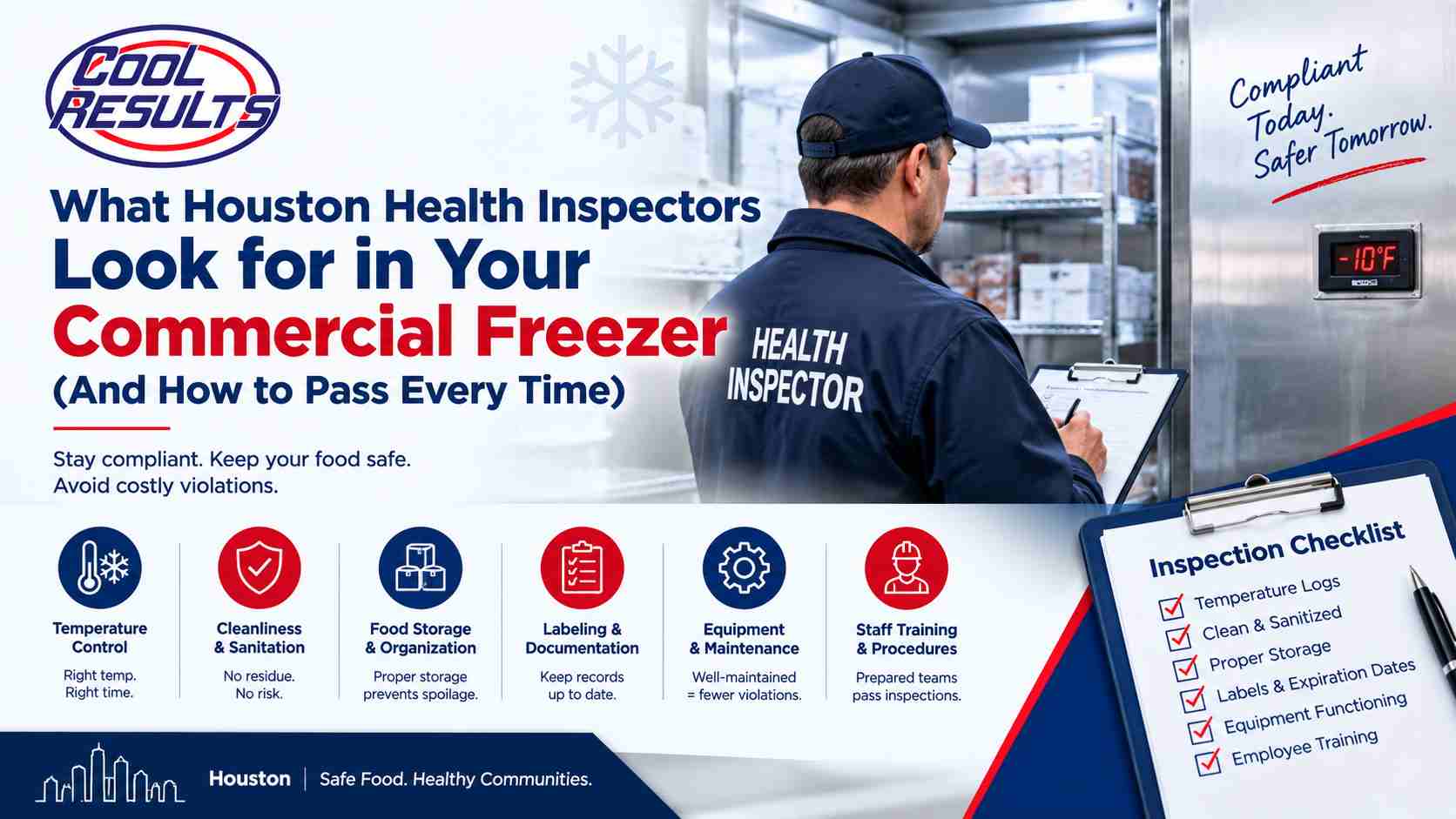
Health inspections in Houston are conducted by Harris County Public Health under authority from the Texas Department of State Health Services (DSHS). They happen without advance notice, they happen regularly — typically two to four times per year for most restaurant categories — and they cover commercial refrigeration with a level of technical detail that catches many Houston restaurant operators off guard. A commercial freezer that looks functional from the outside can still generate a violation notice if it cannot demonstrate proper temperature maintenance, if door seals are compromised, if there is evidence of frost contamination, or if temperature logs are incomplete. Understanding exactly what Houston health inspectors look for in your commercial freezer is the first step toward ensuring your refrigeration equipment never becomes the reason your restaurant fails an inspection.
DSHS Temperature Guidelines for Commercial Freezers in Houston
The Texas Food Establishment Rules (TFER), administered by DSHS and enforced by Harris County health inspectors, establish clear temperature requirements for commercial freezer operation. Commercial freezers are required to maintain frozen food at temperatures that prevent thawing and microbial growth. The specific standard: freezers must keep food at 0°F (-18°C) or below for long-term frozen storage. During inspection, inspectors use calibrated probe thermometers to take readings at multiple points inside the freezer — typically measuring air temperature and the internal temperature of a food item (often a protein or prepared item) stored within the unit. A freezer reading 15°F or 20°F during inspection may generate a temperature violation notice even if the unit is technically operating. Inspectors look for systems that maintain proper temperature, not systems that are trying to.
Most Common Freezer-Related Violations in Houston Health Inspections
Harris County health inspection records consistently show these freezer-related violation categories appearing across Houston restaurants:
- Improper cold holding temperature — the most common freezer violation. The unit is not maintaining food at 0°F or below. Causes range from dirty condenser coils to failing compressors to improper loading (overpacking the unit restricts airflow and creates warm zones).
- Equipment not maintained in good repair — inspectors look at the physical condition of the freezer, not just its temperature. Cracked door gaskets, broken door hinges, damaged interior shelving, and rust or corrosion on internal surfaces all generate violation notices.
- Accumulation of ice or frost on interior surfaces — excessive frost buildup indicates a failed or inadequate defrost system. Beyond the violation itself, frost buildup reduces storage space and can contaminate stored food.
- Thermometer not provided or not accurate — Houston food code requires a thermometer visible within or immediately accessible to each commercial freezer. If it is missing or its calibration is questionable, it is a violation.
- Evidence of pest activity near or inside refrigeration equipment — condensation lines, drain pans, and the areas beneath and behind commercial freezers attract pests. Droppings or evidence of pest activity near freezers generates serious violation notices.
How a Malfunctioning Freezer Fails a Houston Inspection Even If Food Looks Fine
Many Houston restaurant operators make the mistake of assuming that frozen food that appears frozen is evidence of a compliant freezer. Houston inspectors do not share this assumption. An inspector who measures a freezer air temperature of 18°F (rather than 0°F or below) will note the violation even if all items inside appear frozen solid. Why? Because 18°F is above the required storage temperature, and surface appearance alone does not confirm that all items — particularly items in the center of packages or deeper in the unit — have maintained proper temperature throughout their storage history. Inspectors are trained to look at system capability, not just the state of food at the moment of inspection. A freezer that is barely holding 18°F in a cool morning kitchen may be reaching 28°F or higher during a busy afternoon service — a distinction that an instantaneous inspection temperature cannot capture but that trained inspectors understand and account for.
What Houston Inspectors Physically Check on Your Commercial Freezer
When a Harris County inspector examines your commercial freezer, here is what they are physically checking:
- Air temperature — measured with a calibrated probe thermometer at multiple interior locations.
- Food temperature — at least one probe reading taken inside a stored food item, typically the one most likely to be at risk.
- Door seal condition — they will run a gloved hand around the entire door perimeter feeling for gaps, cracks, or soft spots in the gasket.
- Interior frost and ice accumulation — excessive frost on walls, coils, or shelving is a direct violation of TFER cleanliness and maintenance standards.
- Thermometer presence and accessibility — a thermometer must be visible inside or immediately adjacent to the unit.
- General physical condition — cracked or damaged interior surfaces, broken shelving, evidence of rust or deterioration.
- Temperature log availability — some Houston restaurants maintain temperature logs; inspectors may ask to review them as evidence of ongoing monitoring.
Pre-Inspection Checklist for Your Commercial Freezer
Before every service period — and particularly if you believe an inspection may be approaching — walk through this checklist: Verify the freezer display temperature is at or below 0°F. Check door seals by closing the door on a piece of paper: if the paper slides out easily, the seal needs replacement. Confirm a working, visible thermometer is in or adjacent to the unit. Check interior surfaces for visible frost accumulation beyond a thin layer on the evaporator coil. Ensure the freezer is not overpacked — airflow must circulate freely around items for the unit to maintain consistent temperatures throughout. Confirm the exterior condenser coils (usually on the bottom or back) are free of obvious dust accumulation. If anything on this checklist is not passing, schedule a maintenance or repair call before your next inspection.
How Cool Results Helps Houston Restaurants Stay Inspection-Ready
Cool Results provides commercial freezer repair and preventive maintenance throughout Houston that is specifically designed to keep your equipment operating within Harris County health inspection standards. Our bi-annual maintenance contracts include condenser cleaning, defrost system inspection, door seal assessment, thermostat calibration, and a written service report that documents the condition of your freezer at the time of service. This documentation also serves as evidence of due diligence in the event of an inspection. When our technicians identify a component that is at risk of failing — a seal, a defrost heater, a fan motor — we report it and give you the opportunity to address it before it becomes a violation notice.
📞 Don’t let your commercial freezer be the reason your Houston restaurant fails a health inspection. Call Cool Results at (713) 344-4957 to schedule a maintenance visit or emergency repair. Serving all Houston restaurant districts. TDLR licensed. Labor warranty on every repair.
Frequently Asked Questions
Q: What temperature does Houston require for commercial freezers?
A: Texas DSHS and Harris County food code require commercial freezers to maintain food at 0°F (-18°C) or below. Inspectors measure both air temperature and food temperature with calibrated probe thermometers.
Q: What do Houston health inspectors most commonly cite commercial freezers for?
A: The most common violations are improper cold holding temperature, damaged door seals, excessive frost buildup, missing or inaccurate thermometers, and general equipment not maintained in good repair.
Q: Can my freezer fail a Houston health inspection even if the food looks frozen?
A: Yes. Inspectors measure actual air and food temperatures with calibrated instruments. A freezer holding 18°F will receive a violation notice regardless of how frozen the food appears.
Q: How can Cool Results help me pass Houston health inspections?
A: We offer bi-annual preventive maintenance contracts that include condenser cleaning, defrost system inspection, door seal assessment, thermostat calibration, and written service documentation — keeping your freezer compliant year-round.